As we are fast approaching the 5 April 2022 fiscal year end, now is a good time to consider your circumstances for general year-end tax planning. Particularly of note are certain milestones for non-UK domiciled individuals.
In addition, we have included various other items that you may wish to consider as part of your tax optimisation strategy.
Note that some of these topics are complex, the purpose of this content is to provide a background of the relevant topics and to prompt discussions where required.
US persons: Please note a US person you must consider the US tax position for each of the below items to ensure that it is effective for UK and US tax purposes. Most of the ideas detailed below may be appropriate for a US person under the right circumstances.
Becoming Deemed Domiciled, resident for 7 out of the last 9 years or 12 out of the last 14 years
Non-UK domiciled individuals may elect to be taxed in the UK on the remittance basis – this protects foreign income against UK income and capital gains tax to the extent that this remains offshore and is not brought to the UK.
For the first seven years of UK residence there is no charge for the use of the remittance basis, however after this a fee of £30,000 is levied. When you have been resident for twelve of the previous fourteen years this fee is then increased to £60,000 and when you are UK resident for the last fifteen out of twenty years you are no longer able to claim the remittance basis.
Once you have been resident in the UK for the previous fifteen out of twenty years you are considered deemed domiciled in the UK for income tax, capital gains tax and inheritance tax. It is therefore important to consider any planning that can be beneficial. Note that part years count as full tax years for this purpose.
Example 1 – Resident 7 out of the last 9 years
“A” arrived in the UK in the tax year ended 5 April 2016 (the 2015/16 tax year),“A” will have been UK resident for 7 out of the last 9 years as of 06 April 2022 and will need to pay the £30k remittance basis charge in order to claim the remittance basis for the tax year 2022/23.
Example 2 – Resident 12 out of the last 14 years
“B” arrived in the UK in the tax year ended 5 April 2011 (the 2010/11 tax year),“B” will have been UK resident for 12 out of the last 14 years as of 06 April 2022 and will need to pay the £60k remittance basis charge in order to claim the remittance basis for the tax year 2022/23.
Actions for example 1 &2 – Review foreign income to assess whether the remittance basis is still favourable. Review offshore assets for UK compliance.
Example 3 – Deemed Domiciled
“C” arrived in the UK in the tax year ended 5 April 2008 (the 2007/08 tax year), “C” will have been UK resident for 15 out of the last 20 years as of April 6 2022 and will become deemed domiciled for Income, Capital gains and Inheritance tax in the UK for the 2022/23 year onwards.
Actions for example 3 – Review inheritance tax position before deemed domicile status comes into effect. Review offshore assets for UK compliance.
Excluded Property Trust
• Excluded property trusts can provide effective tax planning for individuals approaching deemed domicile status.
• This planning involves settling an offshore trust to hold non-UK assets which will shelter from inheritance tax when deemed domicile status comes into effect.
• An Excluded Property Trust can also provide shelter from UK income tax and capital gains tax.
• Trusts are not always the best approach, but they should be considered in conjunction with tax efficiency planning.
If this is something that you would like to consider we would advise you contact us as soon as possible, as typically at least one month lead time is required to consider and establish such one.
Business Investment relief
Non-UK Domiciled individuals need to take care when remitting overseas funds to the UK. Business investment relief allows individuals to make a non-taxable remittance to the UK for the purpose of making a qualifying investment in a company.
• It is possible to invest into EIS or SEIS companies using this relief.
• It is possible to invest into your own business.
• It is possible to make investments into a property rental business.
• We are able to obtain HMRC advance clearance on transactions, thus attaining certainty on the non-taxation of remittances to the UK. There are various other qualifying conditions, we can discuss this with you if this is of interest.
Pensions
Many individuals utilise pensions as part of their overall tax planning strategy. At the end of the UK tax year, it is worth reviewing your pension contributions for the year and consider any optimisation.
• You are entitled to pay in up to £40,000 tax free per year, but this is tapered once your income exceeds £240,000 to a minimum of £4,000 allowance when your income exceeds £312,000.
• Unused allowances are carried forward for three years.
• Tax relief for pension contributions is claimed on your tax return where contributions are made net of tax.
• If you or your employer overpays into your pension you could be liable to an additional tax charge.
• You should also keep an eye on your pension lifetime allowance (£1,073,100) and understand the consequences of your pension exceeding this amount.
• Speak to us about your pension contributions, so your position can be reviewed and optimised.
Non-UK mutual funds and other offshore funds
• If you are approaching 7 years or 15 years since you arrived in the UK, the remittance basis of taxation may not be the most efficient option or no longer available after 15 years. This means that your non-UK income may be brought into the scope of UK taxation.
• It is important to review your investment portfolio, there may be changes required within your portfolio to ensure that your investments are UK efficient. For example a US mutual fund (non-reporting fund for UK purposes) may be liable to income tax(45%) on such income gains, as well as the fact that other losses are not allowable against such gains. It is imperative to review your portfolio in such circumstances.
• There may be other tax mitigation strategies that can be enacted before the assets become liable to UK taxation.
• Please speak to us if you want to make sure your investments are working for you in the most tax efficient way.
Inheritance Tax
• UK Inheritance Tax (IHT) is assessed on the estate of a deceased individual.
• Domicile status can have a significant impact on the exposure to Inheritance Tax.
• Broadly, each UK individual has a nil rate IHT allowance of £325,000 (this can be increased to £500,000 where the estate includes your primary residence). Assets in the estate in excess of the tax free allowance are generally charged at 40%.
• Effective planning may include setting up a trust, gifting assets, changing the composition of the estate to include exempt assets.
• Please let us know if you would like a review of your affairs for Inheritance Tax planning.
Family Investment Company (FIC)
• A family investment company (FIC) is a private limited company which is used as a long term investment vehicle.
• Can provide an effective way to shelter income and assets from higher rates of taxation and Inheritance Tax.
• The FIC can retain profits for investment rather than those profits being drawn out and being subject to higher rates of personal tax in the hands of the shareholders.
• The FIC can be used as an effective tool to manage the passing down of assets to future generations in a controlled and tax efficient manner e.g. gifting non-voting shares to mature offspring.
Before an FIC is implemented, one must carefully consider if it is an appropriate strategy for you and your family’s long-term circumstances. I would advise that before implementing such a strategy you must seek tax and possibly legal advice.
Other Opportunities
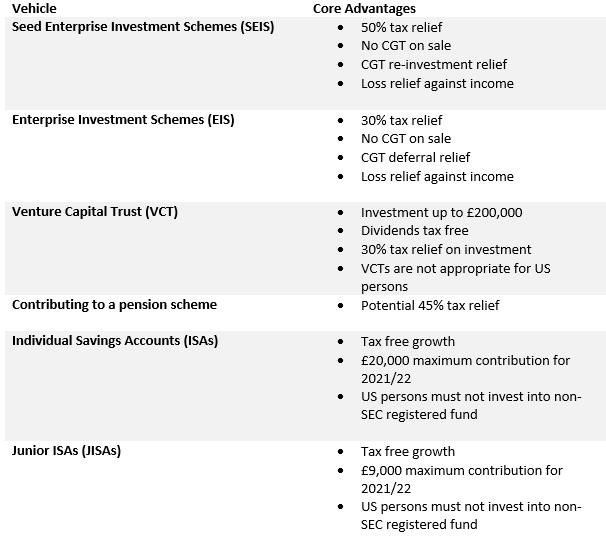
If you are interested in further tax planning, then the following tax-efficient investments are also available. If you are considering any tax planning opportunities for the future, please get in touch. We have provided an overview below but please note that there are qualifying conditions and limits on these investments. In addition, clients that are US citizens may need further considerations.
I would advise that the above issues are considered carefully and where appropriate care and particlular thought is given to milestones that will pass, after which there is no ability to rectify the position. Additionally, ensuring the strategies are appropriate for both UK and US tax(where appropriate) purposes can be complex, it is likley to require professional advice from an adviser who understands the interaction between UK and US tax. Nonetheless, it is impertive that some of the above matters are given due consideration.
Please do not hesitate to contact our team here at Frontier Group and we are happy to arrange a consultation.
Frontier Fiscal Services Limited
|